Work Breakdown Structure (WBS): Deliverables to Work Packages
A Work Breakdown Structure decomposes a project deliverable into a hierarchy of outputs until work packages are assignable, estimable, and verifiable. Children of a parent should cover that parent completely, with no silent extras. It is a scope tree, not a schedule and not a RACI chart.
Framework Card
- Name:
- Work Breakdown Structure (WBS)
- Goal:
- Decompose a project deliverable into a hierarchy of outputs until work packages are assignable, estimable, and verifiable, with children covering each parent completely.
- Flow:
- Name the deliverable → Decompose into components → Stop at work packages → Check the 100% Rule
- Best For:
- A large deliverable whose scope is still a slogan; Bottom-up estimates that need a complete tree of outputs; Change control that needs a visible boundary for what is in and out
Why it matters
Large work often lives as a slogan: “launch the site,” “migrate the platform,” “open the office.”
Everyone nods. Estimates bounce because people are pricing different imaginary trees. Two teams build overlapping pieces. A late request slides in because there was no picture of what “in” meant. Motivation advice to “break it into small steps” can produce a personal list that still does not add up to the deliverable.
A WBS is a shared tree of what will exist when the work is done. It will not date the work, and it will not assign who is Accountable. It will make missing and extra scope visible.
What it is
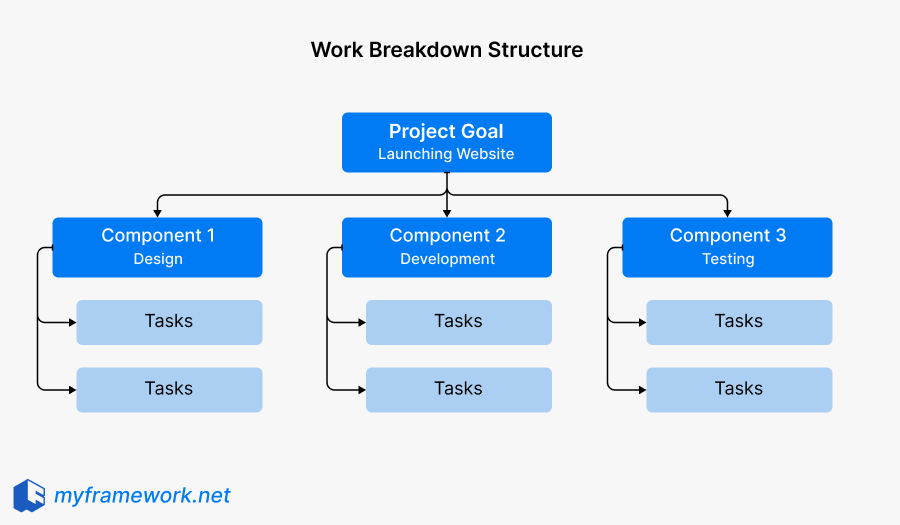
A WBS is a hierarchical decomposition of project scope, oriented to deliverables.
| Level (teaching) | What it names |
|---|---|
| Root | The project deliverable (a noun: what will exist) |
| Major components | Complete, non-overlapping parts of that deliverable |
| Work packages | Lowest elements that can be assigned, estimated, and checked as done |
The 100% Rule: at each level, the children together are the parent. Nothing extra, nothing missing, no double-counting.
Production teaching sometimes attributes WBS to Harold Kerzner. Kerzner is a widely read project-management teacher. The WBS as a practice comes from mid-20th-century government and project-management use, later stated in PMBOK-style language. Treat Kerzner as a popularizer, not as the sole inventor, and do not treat WBS as a mathematical factorization.
Name outputs, not process. “Homepage wireframe” can be a node. “Do design” cannot.
How it works
A useful pass is root, decompose, stop, then check completeness.
1. Name the deliverable
Write the root as an output (“Launched marketing site,” not “Work on the website”). If two roots compete, you may have two projects.
2. Decompose into major components
Split by natural parts of the output (for a site: design artifacts, working software, content, test evidence). Siblings should not overlap. Together they should be the parent.
3. Stop at work packages
Continue until a node is assignable to a role, estimable, and has a done test. Stop when further splits no longer help. Hour-band heuristics you may have heard (for example an 8 to 80 hour range) are teaching aids, not laws.
4. Check the 100% Rule
Walk each parent: do the children fully represent it? Is anything listed twice? Is “how” sneaking in as a verb-only node?
Then use the tree for estimates, assignment conversations, and change control. Dates and RACI remain other artifacts.
How it compares
When another lens fits better, or when you need a complementary view, these frameworks do different jobs.
| Framework | What it helps you see | How it differs from WBS |
|---|---|---|
| RACI Model | Responsible, Accountable, Consulted, Informed | Roles on work. WBS is the work tree. |
| SMART Goal Framework | Whether a goal is specific and checkable | Goal quality, not hierarchical scope. |
| VITALS Method | Restart a stall with validation and micro-steps | Personal initiation, not project decomposition. |
| PDCA Model | Plan, Do, Check, Act as an improvement cycle | Tests a change. WBS structures what the project includes. |
A WBS is the lens for deliverable-oriented scope. Other methods help when the question is roles, goal wording, restarting a person, or cycling an improvement.
When to Use This Framework
- A deliverable whose parts are not visible. People cannot estimate because they disagree on what is included.
- Bottom-up estimates. You need a complete tree of outputs before rolling numbers up.
- Change control. You need a boundary so new requests are visible as change, not silent extra branches.
Example
A concrete example makes the structure easier to reuse when you are under uncertainty.
Example: “Launch the website”
Root: launched company website (public, on-brand, with legal pages).
Major components might be: information architecture and visual design artifacts; implemented templates and integrations; approved content set; test and launch evidence.
A work package under content might be “Approved product-page copy set” with a reviewer named later in RACI, not inside the WBS node title. “Write better copy” is not a node.
Implication: A request for a new language is a new branch (change), not a silent extra. The tree did not schedule the launch.
Example: Office move treated as tasks
A facilities lead lists: pack, hire movers, notify IT. Those are activities. A WBS-shaped tree would start from the deliverable “Team operational in new site” and include outputs such as: assigned seats and access; moved inventory in place; working network ports; updated emergency information. Packing is how, not what. IT notify is a communication action that belongs on a schedule or RACI once the outputs exist.
Takeaway
What a WBS can help with
- Making a slogan-sized goal into a tree of outputs
- Stopping decomposition at assignable, estimable, verifiable work packages
- Checking completeness with the 100% Rule
- Giving change control a visible boundary
What a WBS cannot replace
- RACI. Who is Responsible or Accountable is role assignment on work, not the tree itself.
- SMART goals. Quality of an objective statement is not decomposition.
- A schedule. Gantt and critical path answer when. WBS answers what.
- A product backlog for ongoing discovery. Emergent work that should not be fully decomposed yet is a different style.
- VITALS. Restarting a personal stall is not project scope.
- A promise of zero scope change. The tree makes change visible. It does not freeze the world.
Honest scope: WBS structures scope. It should not be sold as a formula or as a complete project system.
Frequently asked questions
The lowest WBS element that can be assigned, estimated, and verified as done. If you cannot tell when it is complete, it is still too vague.
It makes the boundary visible. A request that is not in the tree is a change, not a silent extra. It does not by itself stop stakeholders from asking.
No. A WBS is what. A schedule is when. You often need both. They are not the same artifact.
RACI says who is Responsible or Accountable on work. WBS says what the pieces of the deliverable are. Assign roles after the tree exists, or you will assign people to slogans.
He is a well-known project-management teacher. WBS as a practice is older government and professional project-management use. This page treats the method as a scope tree, not as one person’s formula.