ZOPA: Find Whether a Deal Range Exists
ZOPA (Zone of Possible Agreement) helps you test whether both sides' walk-away terms overlap on this issue. If they do, you have a possible deal range. If they do not, you are in a negative bargaining zone and more offers on the same numbers will not create a deal.
Framework Card
- Name:
- ZOPA
- Goal:
- Test whether both sides' walk-away terms overlap, then name the possible deal range or the fact that no range exists on this issue.
- Flow:
- Name the issue and sides → Estimate each reservation → Test for overlap → State the range or no-overlap implication
- Best For:
- Checking whether a price or term gap is bridgeable; Salary, contract, or bid talks before more bargaining; Seeing a negative zone when walk-aways do not overlap
Why it matters
In a live bargain you usually know your own limit. You are guessing theirs. You offer, they counter, and the room treats movement as progress.
Sometimes the offers are already inside an overlap and nobody has named it. Sometimes there is no overlap at all, and another round of the same issue only burns time. The costly error is the same in both cases: people argue about the next number before they ask whether a range exists.
ZOPA is a habit of naming walk-away terms and checking for overlap. It is not a promise that a zone will appear, and it is not a formula for the "right" price inside a zone.
What it is
The Zone of Possible Agreement is the overlap of terms both sides could still accept. Everyday names for the same idea include bargaining range and negotiation zone.
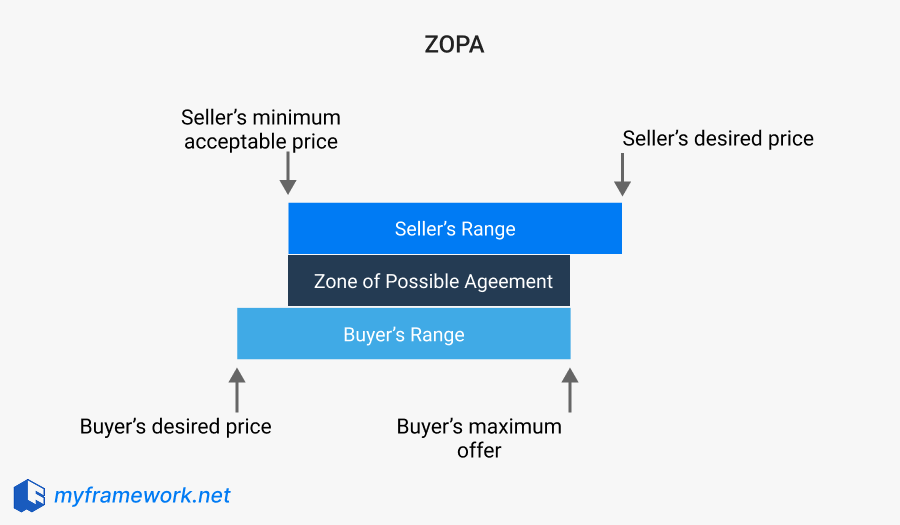
Each side has a reservation: the worst terms they would still take. A seller's reservation is often a minimum price. A buyer's reservation is often a maximum. When the buyer's maximum sits above the seller's minimum, a ZOPA exists between those two numbers. When it does not, the situation is a negative bargaining zone.
BATNA (Best Alternative to a Negotiated Agreement) is the path you take if this deal fails. People often use BATNA to set their reservation. BATNA is not the zone. The Harvard Negotiation Principle is a broader interest-based method that can change the issue set. That method is not ZOPA either.
How it works
A useful ZOPA pass is an overlap diagnosis, not a list of negotiation slogans.
1. Name the issue and the two sides
Pick one issue (price, salary, term length) and the two parties. Mixing several issues in one range blurs the test. Other issues can be added later if you are trying to widen a thin zone.
2. Estimate each reservation
State your walk-away. Estimate theirs, and label the estimate as a guess unless they have disclosed it. Opening offers are not reservations. A BATNA often informs the walk-away: if the alternative is better than this deal, the reservation should reflect that.
3. Test for overlap
If the acceptable ranges overlap, a ZOPA exists. If they do not, you have a negative bargaining zone. Do not treat "we are close" as overlap unless the numbers (or equivalent terms) actually cross.
4. State the range or the implication
If a zone exists, name it as a possible range, not as the fair outcome and not as the close. If it does not, the honest outputs are: walk away, or change the issue set (trade another term, add a non-price item) so a new test is possible. Changing the issue set is neighboring work, often Harvard-style mutual gains. It is not proof that the original ZOPA was hiding.
Review the diagnosis when new information arrives. A reservation can move. A zone is a snapshot.
How it compares
When another lens fits better, or when you need a complementary view, these frameworks do different jobs. They are not interchangeable labels for the same question.
| Framework | What it helps you see | How it differs from ZOPA |
|---|---|---|
| Harvard Negotiation Principle | Interests, options, and separating people from the problem | A full method. ZOPA is the overlap test on stated terms. |
| BATNA | The walk-away alternative if this negotiation fails | Often sets reservation. It is not the overlapping range. |
| Thomas-Kilmann Conflict Mode | Compete, collaborate, compromise, avoid, accommodate | Style under tension. ZOPA is a range diagnosis, not a style choice. |
ZOPA is the lens for whether a deal range exists on this issue. Other methods help when the question is interest-based process, walk-away design, or conflict style.
When to Use This Framework
- Salary talks. A budget cap and a candidate minimum may or may not overlap.
- Real estate or other bid-ask gaps. The question is whether the spread is bridgeable on price.
- Supplier or contract bands. Each side has a walk-away on fee, term, or volume.
Example
A concrete example makes the structure easier to reuse when you are under uncertainty.
Example: Salary band that may not exist
A hiring manager can go to $92,000. The candidate has said they need $98,000 and has another offer at $96,000. Both sides keep sending numbers in the mid-90s.
A ZOPA pass on base salary (illustrative, not a measured case):
- Manager reservation: $92,000.
- Candidate reservation, informed by BATNA: about $96,000.
- Overlap on base salary: none.
Implication: More mid-90s offers will not close base pay. The next honest move is to walk, or to test a different package (start date, bonus, remote days) and run the overlap test again on that set. Pretending a ZOPA exists on base salary would hide the negative zone.
Example: Used-car overlap
A seller will not go below $5,000. A buyer will not go above $5,500. Offers have been $5,400 and $5,100.
- Seller reservation: $5,000.
- Buyer reservation: $5,500.
- ZOPA: $5,000 to $5,500.
Implication: A deal on price is possible inside that band. $5,200 is inside the zone. It is not therefore the "winning" price. If the buyer can only pay $4,750, the same pair is a negative zone and price-only bargaining will not close.
Takeaway
What ZOPA can help with
- Seeing whether walk-away terms overlap on a named issue
- Naming a possible range when they do
- Naming a negative bargaining zone when they do not
- Stopping another round of offers that cannot close
What ZOPA cannot replace
- A full interest-based method. The Harvard Negotiation Principle works interests, options, and people-versus-problem. ZOPA only tests overlap.
- BATNA as a system. BATNA is the alternative if this deal fails. It often sets reservation. It is not the zone.
- Conflict style. Thomas-Kilmann describes how people handle conflict. It does not compute a deal range.
- A fairness or closing formula. A number inside the zone can still be a bad deal for other reasons (risk, relationship, hidden cost).
- Perfect knowledge of the other side. Their reservation is often estimated. Label the guess.
Honest scope: ZOPA structures an overlap judgment. It does not replace the methods above, and it should not be sold as a winning-price calculator.
Frequently asked questions
A named issue, two reservations (yours stated, theirs labeled if estimated), a yes/no on overlap, and either a possible range or a negative-zone implication. If the output only says "find common ground," you do not have a diagnosis yet.
BATNA is what you do if this deal fails. ZOPA is whether the two walk-away terms overlap. People use BATNA to set reservation. They are not the same object.
No. It means a deal on those terms is possible. Whether the deal is wise still depends on risk, other issues, and alternatives.
The walk-aways do not overlap. On price, the buyer's maximum is below the seller's minimum (or the equivalent on another term). More offers on the same issue will not create overlap.
Not by repeating the same numbers. You can change the issue set (another term, a non-price item) and test again. That is neighboring work, not a hidden zone on the original issue.