4 Patterns of Team Conflict: Name the Geometry Before You Intervene
The 4 Patterns of Team Conflict helps you name repeating friction as one of four geometries (Sole Dissenter, Boxing Match, Warring Factions, Blame Game), then match the next move to that shape. It is a diagnosis, not a personality verdict and not a full mediation method.
Framework Card
- Name:
- 4 Patterns of Team Conflict
- Goal:
- Name the team's conflict geometry (Sole Dissenter, Boxing Match, Warring Factions, or Blame Game) so the next intervention matches that pattern.
- Flow:
- Sole Dissenter → Boxing Match → Warring Factions → Blame Game
- Best For:
- Recurring team fights that keep the same shape; Decision deadlocks that repeat the same argument; Post-miss conversations that turn into blame
Why it matters
Teams argue. That is not the interesting part. The interesting part is when the same argument returns in the same shape: one person always against the room, two people boxing, two camps, or a post-mortem that is only blame.
Leaders often apply one move to all of those: "let's be more respectful," or "let's take it offline." The move might fit one pattern and miss the others. Misdiagnosis wastes the next three meetings.
This lens asks you to see the geometry first. Production teaching attributes the four patterns to Peterson (Harvard Business Review). Treat that as the source of the names, not as a proof that any intervention will restore performance.
What it is
The 4 Patterns of Team Conflict is a diagnostic set of four interaction shapes.
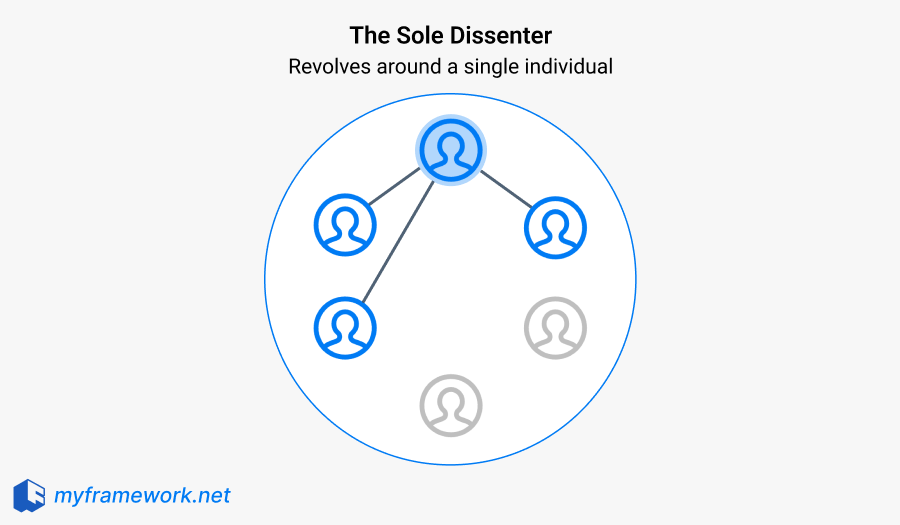
Sole Dissenter. One person consistently opposes the majority. The risk is that the group silences them, or that they become the only brake and everyone else stops thinking.
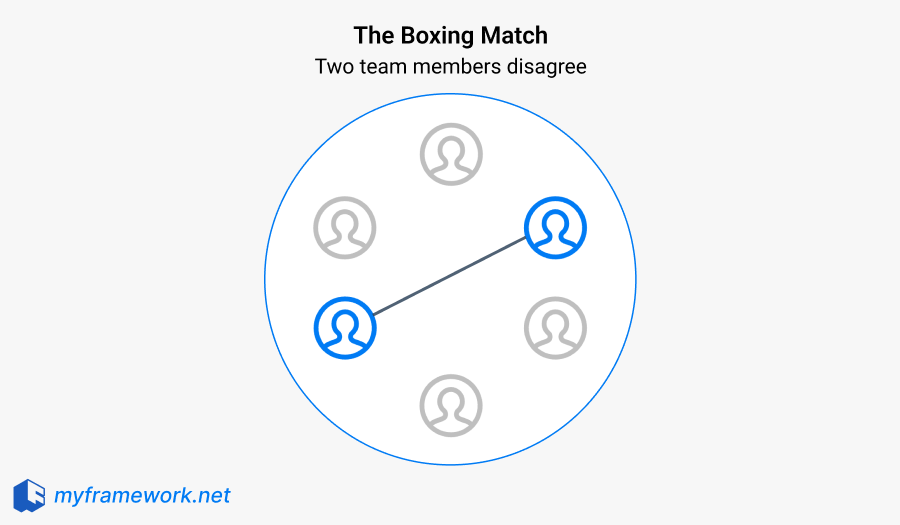
Boxing Match. Two people take the fight. The rest of the team watches. The agenda becomes their bout.
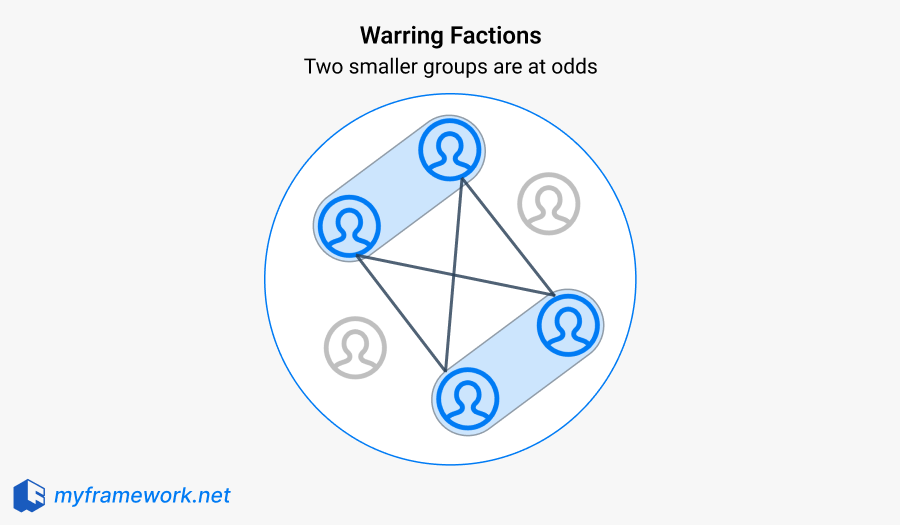
Warring Factions. Subgroups form camps, often with "our way" versus "their way" (legacy teams, functions, or merger groups).
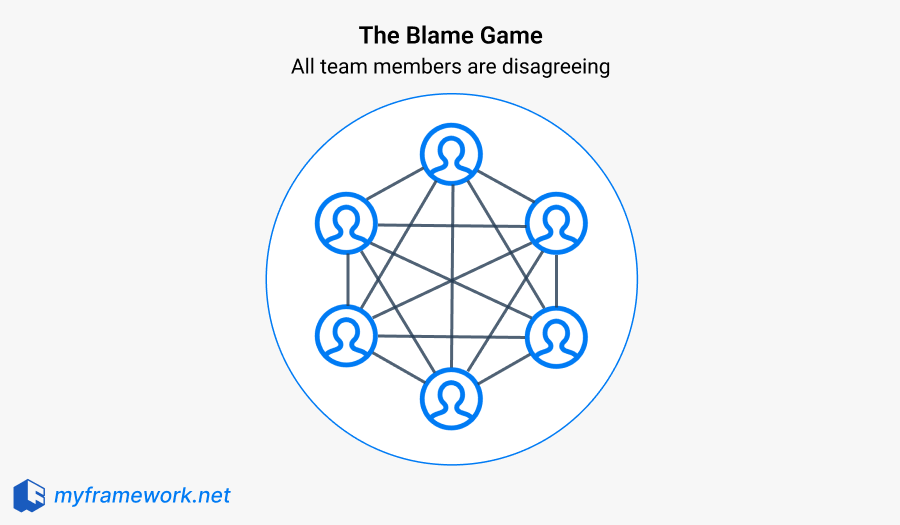
Blame Game. After a miss, energy goes to who is at fault. Cause analysis never starts. People protect themselves.
The method is: collect signals, name the dominant pattern, then choose a move that fits that pattern. Teams can show more than one shape. Say which is dominant this week.
This is not a list of personality types. A dissenter can be right. A boxing match can be two people who both care. The pattern is the structure of the fight, not a moral ranking.
How it works
A useful pass is signals, a named pattern, then a matched move. It is not a poster of four labels.
1. Collect signals
Who speaks, who goes silent, whether the fight is a pair or a camp, whether the energy is "against the idea" or "whose fault." Use meetings you have actually seen. Do not invent a pattern from one tense hour unless it already repeats.
2. Name the dominant pattern
Pick the best fit of the four. If two fit, say so and choose which one is driving this week's cost (for example, factions underneath a boxing match).
3. Match the intervention to the pattern
Production teaching (sketches, not a complete practice):
- Sole Dissenter: make the dissenting view speakable; ask what they see that the majority does not; do not use the group to shut them down, and do not let one person veto every decision without a reason.
- Boxing Match: stop the spectator sport; ground rules; move from positions to interests; if needed, a neutral third person, not more audience.
- Warring Factions: work that requires the camps together; shared goal that neither camp owns alone; forums that air the split without a pep talk.
- Blame Game: separate learning from punishment for this review; ownership of the system, not a hunt; if someone must be accountable, name it without turning the whole hour into a trial.
The move should fit the pattern you named. A team-building offsite is a poor first move for a blame game after a outage.
How it compares
When another lens fits better, or when you need a complementary view, these frameworks do different jobs. They are not interchangeable labels for the same question.
| Framework | What it helps you see | How it differs from the 4 Patterns |
|---|---|---|
| Thomas-Kilmann (TKI) | A person's preferred conflict mode | Individual style. This method is team interaction geometry. |
| Tuckman Model | Forming, storming, norming, performing | Developmental stage. Storming is not four named fight shapes. |
| SCARF Model | Status, Certainty, Autonomy, Relatedness, Fairness | Social threat domains, not Sole Dissenter / camps / blame. |
| Radical Candor | Care and challenge in feedback | Stance for a conversation, not a team-pattern diagnosis. |
The 4 Patterns of Team Conflict is the lens for naming repeating team geometry, then matching a move. Other methods help when the question is personal style, team stage, threat, or feedback stance.
When to Use This Framework
- Retrospectives that feel stuck with no technical blocker named.
- Decision deadlock where the same two arguments return every week.
- Merger or legacy-group tension where camps defend "how we did it."
- Reviews that call conflict an "attitude problem" before anyone mapped the interaction.
Example
A concrete example makes the structure easier to reuse when you are under uncertainty.
Example: Platform team, same design review every sprint
A platform lead watches a weekly design review. One senior engineer objects to every API change. Two product managers have started talking only to "their" engineers. After last month's incident, the first 20 minutes of retro were about whose ticket was late.
Signals this month: the senior engineer's objections are consistent (sole dissenter). The PM split is starting to look like camps (warring factions). Blame is present but not yet the whole meeting.
Dominant pattern this week: Sole Dissenter, with a faction risk.
Implication: The lead makes the engineer's objections a listed design input (what breaks if we ship) instead of a personality fight. They do not start with a merger-style offsite. They also do not treat TKI "avoiding versus competing" as the diagnosis: the geometry is a one-against-many design review, not a personal style score. If the camps harden next month, the pattern call should change.
Takeaway
What the 4 Patterns can help with
- Naming repeating team friction as one of four geometries
- Matching a first intervention to that shape
- Catching the habit of treating every fight as personality
- Seeing when a deadlock is a pair, a camp, or a blame loop
What the 4 Patterns cannot replace
- Thomas-Kilmann (TKI). TKI describes how a person tends to handle conflict (compete, collaborate, and the rest). This page is team geometry.
- Tuckman. Tuckman is a stage model of team development. Storming is not the same as four conflict patterns.
- SCARF. SCARF names social threat domains. Useful for why people go defensive. Different unit of analysis.
- Radical Candor. Radical Candor is a feedback stance. It does not diagnose camps versus a boxing match.
- Mediation, HR investigation, or incentive redesign. Pattern names do not replace those processes when harm, policy, or pay is the real driver.
Honest scope: the four patterns structure a diagnosis. They should not be sold as a way to restore high performance by themselves.
Frequently asked questions
Yes. Name a dominant pattern for this week, and say if a second is forming. Forcing a single label when two are live is a weaker diagnosis.
No. They may be right. The pattern names the geometry (one against many). The intervention is to hear the content, not to silence them or to let them veto without a reason.
TKI scores how a person tends to respond to conflict. This method names how the team's fight is structured.
Say that. Pattern diagnosis does not replace org design. You can still name the geometry of the meetings while you work the system issue.
No. It is a diagnostic cut. Misnaming the pattern leads to a mismatched move. It is not a mediation license and not a performance guarantee.