Thomas-Kilmann Conflict Mode: Five Modes, Two Dimensions
The Thomas-Kilmann Conflict Mode Instrument (TKI) helps you place a conflict on two dimensions, assertiveness and cooperativeness, then choose Competing, Collaborating, Compromising, Avoiding, or Accommodating for this situation. No mode is universally best. It is a situational choice, not a person…
Framework Card
- Name:
- Thomas-Kilmann Conflict Mode
- Goal:
- Place a conflict on assertiveness and cooperativeness, then choose Competing, Collaborating, Compromising, Avoiding, or Accommodating for this situation rather than a habitual style.
- Flow:
- Assertiveness → Cooperativeness → Competing → Collaborating → Compromising → Avoiding → Accommodating
- Best For:
- Choosing a conflict-handling mode when habit is driving the response; Seeing why collaboration is not always available or fitting; Naming the tradeoff between own concerns and the other party’s concerns
Why it matters
Most people have a conflict habit. Some push until they win. Some yield to keep the peace. Some disappear until it blows over. Some split the difference. Some open a workshop for every disagreement.
Those habits sometimes fit. Often they do not. A safety rule may need Competing. A low-stakes preference may need Accommodating. A missing fact may need Avoiding for a day. If you only have a “style,” you will keep using it after the situation has changed.
TKI, developed by Kenneth Thomas and Ralph Kilmann, is a way to see the mix of your concerns and the other person’s concerns, then switch on purpose.
What it is
TKI sits on dual concern theory:
- Assertiveness: how far you try to satisfy your own concerns.
- Cooperativeness: how far you try to satisfy the other person’s concerns.
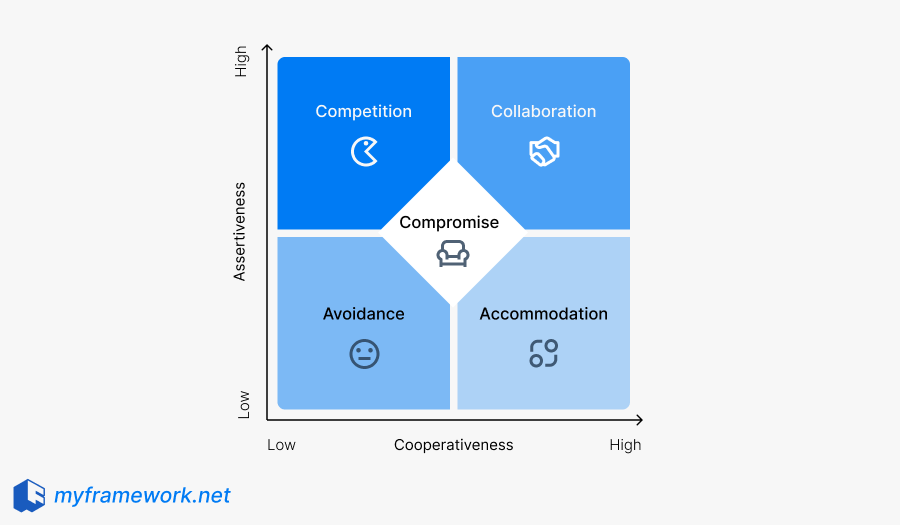
Five modes sit on that grid:
- Competing. High assertiveness, low cooperativeness. Useful when a quick decision or a non-negotiable standard is at stake. Cost: people can feel unheard.
- Collaborating. High on both. Useful when the issue and the relationship both matter and there is time to invent a third option. Cost: time, trust, and joint problem-solving capacity.
- Compromising. Moderate on both. Useful when time is short and both sides must give something. Cost: two partial losses, sometimes dressed up as fairness.
- Avoiding. Low on both. Useful for trivial issues, cooling off, or waiting for information. Cost: the issue can grow.
- Accommodating. Low assertiveness, high cooperativeness. Useful when the issue matters more to the other party or you are repairing goodwill. Cost: your concerns stay unmet if this is the only move.
The skill is switching. A “collaborator personality” is a misunderstanding of the instrument.
How it works
A useful pass is situation, then mode, not a quiz result.
1. Name the situation
What is at stake for you and for them? How much time is there? How much power is uneven? How important is the ongoing relationship?
2. Name the current or default mode
What are you actually doing: pushing, yielding, delaying, splitting, or joint problem-solving? Do not diagnose their personality.
3. Choose a mode for this situation
Match the five modes to the constraints you named. Collaborating is fitting when both sides can still invent options. It is not a moral upgrade.
4. State the tradeoff
Every mode spends something: time, relationship credit, or your own concerns. Name that cost so the choice is honest.
How it compares
When another lens fits better, or when you need a complementary view, these frameworks do different jobs. They are not interchangeable labels for the same question.
| Framework | What it helps you see | How it differs from TKI |
|---|---|---|
| SBI Model | Situation, Behavior, Impact | Wording for one event, not a dual-concern mode choice |
| Radical Candor | Care personally and challenge directly | A feedback stance, not five modes on assertiveness and cooperativeness |
| SCARF Model | Five social threat and reward domains | Threat psychology, not conflict-handling modes |
| The Relationship Map | Supportiveness and frequency of ties | A portfolio of people, not a mode for this conflict |
TKI is the lens for choosing a conflict-handling mix in a situation. Other methods help when the question is how to word feedback, how to care and challenge, or how social threat shows up.
When to Use This Framework
- Negotiation. You need to decide whether to compete, collaborate, or compromise instead of repeating last quarter’s move.
- Team friction. Recurring fights may be a mode mismatch (one person always Competing, the other always Avoiding), not only a technical dispute.
- Time pressure. Crisis and trivia both punish a default to full collaboration.
Example
A concrete example makes the structure easier to reuse when you are under uncertainty.
Example: A launch date fight
Engineering wants two more weeks. Sales has a conference slot that will not move. The PM’s habit is Collaborating (long workshops). There is not time to invent a third calendar.
A TKI pass might choose Compromising on scope (ship a thinner demo) while Competing on the date if the slot is truly fixed, or Avoiding a personality argument in the hallway until a one-hour decision meeting. Collaboration theater would burn the week.
Implication: The “nice” mode was the mismatch. Time made Collaborating expensive.
Example: A peer who owns a craft decision
A designer’s type choice is better than yours and the issue is not a brand-risk. Accommodating is fitting. Competing would win the meeting and lose the work. If the same person later blocks a legal requirement, Competing or Collaborating may fit that later situation. Modes are allowed to change.
Implication: TKI is not “find your style.” It is “pick this week’s mix.”
Takeaway
What TKI can help with
- Seeing conflict as own concerns vs other’s concerns
- Naming five modes without ranking them as mature vs immature
- Matching a mode to time, stakes, and relationship
- Catching a habitual response that no longer fits
What TKI cannot replace
- Feedback wording. SBI describes one situation, behavior, and impact. It does not choose a conflict mode.
- A care-and-challenge stance. Radical Candor is about how you give feedback, not five dual-concern modes.
- Social-threat coaching. SCARF names status, certainty, autonomy, relatedness, and fairness.
- Mediation, labor process, or an abuse protocol. Structural conflict and harm need other processes. TKI does not make unsafe situations safe.
- A personality assessment of the other party. Using the grid to label them is a misuse.
Honest scope: the framework structures a situational mode choice. It does not replace the methods above, and it should not be sold as a way to master conflict or leadership.
Frequently asked questions
No. It needs time, trust, and a problem that can still be invented jointly. Emergencies, trivia, and one-way standards often need a different mode.
A named situation (stakes, time, relationship), the current or default mode, a chosen mode for this case, and the tradeoff you are accepting. A label of your “type” is not enough.
Radical Candor is a stance for feedback. SBI is a sentence pattern for one behavior. TKI chooses how hard you pursue your concerns versus theirs in this conflict.
You can observe their behavior in this episode. You should not treat TKI as their personality. The instrument is for choosing your next move.
Only at the level of the mix (push, yield, delay, split, or joint problem-solving). Wording, facilitation, and legal process are other jobs.