4P Marketing Mix: Product, Price, Place, Promotion
The 4P Marketing Mix helps you inspect Product, Price, Place, and Promotion together so a weak lever is not hidden by a strong one. It is a seller-side checklist, not a promise of business success, and not the same 4P used in content operations.
Framework Card
- Name:
- 4P Marketing Mix
- Goal:
- Inspect Product, Price, Place, and Promotion together so a weak lever is not hidden by a strong one.
- Flow:
- Product → Price → Place → Promotion
- Best For:
- A new offer that needs a go-to-market set; Unclear sales when one lever has been blamed in isolation; Checking whether channel and price match the offer
Why it matters
When an offer is not converting, the room often picks a favorite lever. Cut the price. Buy ads. Add a feature. Each move can be locally reasonable and still make the mix worse: a premium product in a discount aisle, a strong product nobody hears about, a low price that trains the channel to undervalue the offer.
The useful question is not “which P is missing.” It is “which P is out of line with the others.” That is a smaller, more honest job than a theory of all marketing.
What it is
E. Jerome McCarthy’s mix names four levers you can set.
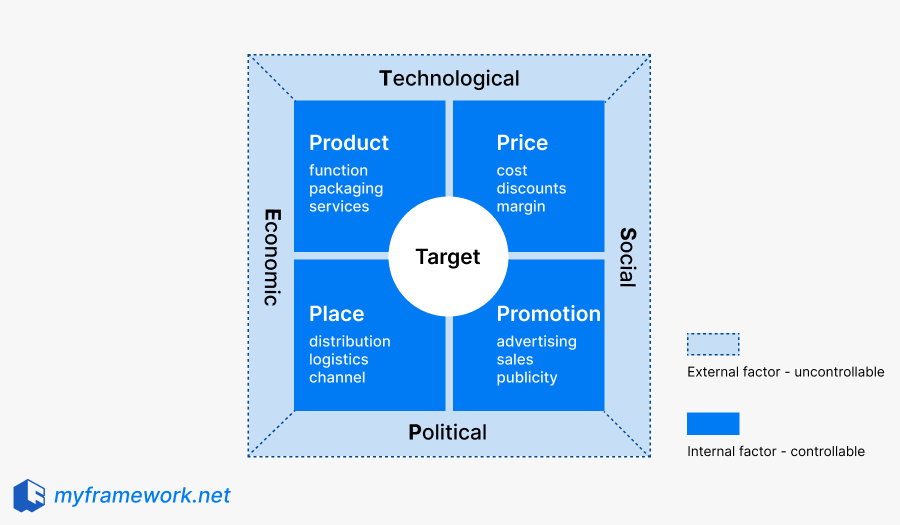
Product is the offer: features, quality, brand, and the job it does. Price is what you charge and on what terms. Place is how the buyer gets it: store, site, partner, app. Promotion is how you communicate that it exists and why it is desirable.
The four are meant to be read as a set. A service still has Product (the service) and Place (where it is delivered). A digital good still has Place (the access path).
This mix is not 4C, which reads the same slots from the buyer’s side. It is not Plan, Produce, Promote, Perfect, which is a content cycle that happens to share the 4P label.
How it works
A useful 4P pass writes each lever from the case, then names the mismatch.
1. Product
What is offered, at what quality, under what brand, for which job.
2. Price
What is charged, compared with cost, alternatives, and the Product story.
3. Place
Where and how the buyer obtains it. Access is Place, including digital.
4. Promotion
How existence and desirability are communicated. Promotion is not Place.
5. Mix coherence
Name the conflict if there is one (premium Product, discount Place; strong Product, silent Promotion). State what you will adjust. Changing one P often forces another. Without that step you have four lists, not a mix.
How it compares
When another lens fits better, or when you need a complementary view, these frameworks do different jobs. They are not interchangeable labels for the same question.
| Framework | What it helps you see | How it differs from 4P mix |
|---|---|---|
| 4C Marketing Model | Needs, total cost, convenience, communication | Buyer side of the same slots |
| 4P Model in Content Marketing | Plan, Produce, Promote, Perfect | A content loop, not Product-Price-Place-Promotion |
| 5A Marketing Model | Path stages | Journey, not mix |
| SWOT Analysis | Internal and external position | A scan, not four levers |
| Value Stick | Value split among customer, firm, and others | Economics of value, not the four mix levers |
The 4P mix is the lens for seller levers read together. Other methods help when the question is buyer burden, content operations, or a journey.
When to Use This Framework
- A new offer. You need to write Product, Price, Place, and Promotion before launch, not after the first miss.
- Unclear sales after one lever was blamed. Price was cut; nothing moved; Place or Promotion was never checked.
- Channel and price mismatch. The offer signals premium; the shelf or marketplace signals bargain.
Example
A concrete example makes the structure easier to reuse when you are under uncertainty.
Example: Feature-rich app, almost no Promotion
A team spent the year on Product. Price is a high subscription. Downloads are low.
Implication: The weak lever is Promotion (and maybe Place: the app is hard to find). Cutting Price first would hide that nobody has heard of it.
Example: Boutique coffee in a discount grocer
Beans and brand are premium. Price is luxury. The only Place is a discount grocery endcap.
Implication: Place fights Price and Product. Moving to specialty retail or direct sales is a mix repair, not a Product rewrite.
Takeaway
What the 4P mix can help with
- A shared checklist of seller levers
- Seeing mismatch among Product, Price, Place, and Promotion
- Planning a launch set that is internally consistent
What the 4P mix cannot replace
- Buyer-side reading. 4C asks about need, total cost, convenience, and dialogue.
- Content operations. Plan, Produce, Promote, Perfect is a different 4P.
- A funnel. 5A stages a path.
- Position or industry structure. SWOT and Five Forces are different jobs.
- Research, a price formula, or a media plan. The mix names levers. It does not compute the number.
Honest scope: 4P structures a seller mix. It does not replace 4C or research, and it should not be sold as a complete marketing theory.
Frequently asked questions
Yes. The service is Product. The fee is Price. Delivery path is Place. Reputation and outreach are Promotion.
The access path: site, app store, partner marketplace, or onboarded tenant.
Place is how they get it. Promotion is how they hear about it.
No. 4C is the buyer-side counterpart. You can use both.
No. That model is Plan, Produce, Promote, Perfect.