An action-orientated review model to convert past experience into practice.
Give feedback that is clear, specific, and actionable by combining Feeling, Fact, and Comparison.
For understanding how great leaders and orgs inspire action by starting with a clear sense of purpose.
Summary of typical conflicts in the workplace, discover proven strategies
A framework enhances understanding, empathy, and responsiveness.
Using dual concern theory to understand and resolve conflicts.
A simple practice to accept the anxiety, anger or sadness and start embracing them.
Deliver objective feedback by separating situation, behavior, and impact.
Your presence speaks louder than your words.
A simple way to start conversations.
A simple way to evaluate your relationships.
Make your pitch or message clear, logical, and action-oriented.
Sharpen your stakeholder management skills via finding who matters most.
Apply five communication elements to make ideas memorable and repeatable.
Gives you a simple and clear structure to build trust fast.
Change up the content every two minutes to keep people engaged.
Structure 30-minute meetings into focused parts for better feedback.
Reveal your points step by step.
Deliver clear, structured arguments by stating your point first, proving it, and closing with clarity.
Expand self-awareness, uncover blind spots, and strengthen trust through structured feedback.
Separate facts from interpretations to respond to feedback calmly and solve the real problem.
Help groups move from information gathering to action in a structured and inclusive way.
Six negotiation principles help both sides get more of what they want.
A practical negotiation concept that defines where a deal is actually possible.
Allows you to handle challenges with clarity, whether you need to see the big picture or focus on the details.
Help individuals and groups connect personal stories to collective action.
Aim to eliminate confusion and miscommunication in both verbal and written forms
Turn complex ideas into clear cause-and-effect stories people remember.
An easy framework to answer "Tell Me About Yourself" in a job interview.
A storytelling framework that makes your message relatable, memorable, and impactful in any context.
Narrate how an idea was born, built, and scaled to demonstrate its real-world impact.
Persuade and inform with clarity by structuring your message.
Deliver clear, non-judgmental feedback by separating facts, impact, and next actions.
Emphasis on timing, ensuring actions are strategically aligned with deadlines for effective goal setting.
Grow your influence via focusing what you can control.
Being a great manager without losing your humanity.
Help people to deliver strong messages or express complex ideas.
Bring clarity, reduce friction to the stakeholder communication.
Capture feedback, act on it, make changes stick, and report back with clarity.
Increase engagement and commitment in the workplace.
Structure your answers and emphasize takeaways to show real growth.
Strengthen alignment between your priorities and your manager’s expectations.
Help you persuade effectively, build trust, and gain support in any professional setting.
Speak their language, not yours.
Helps communicators control emotional rhythm and attention over time.
Resolve complications with concise, executive-ready solutions.
Structure complex messages into a clear narrative that leads the audience to your conclusion.
Structured communication framework which is supporting your point with logically organized details and effective information delivery.
Your presence speaks louder than your words.
No application mappings are available for this framework yet.
Have you ever sent a message that was misunderstood? Maybe you said something in a meeting, but people focused more on your tone than your words. This happens because communication is not just about words.
Albert Mehrabian, a psychology professor at UCLA, developed the 7-38-55 Rule to explain how people interpret messages.
His research in the 1960s found that when we express feelings and attitudes, only 7% of meaning comes from words, 38% from tone of voice, and 55% from body language.
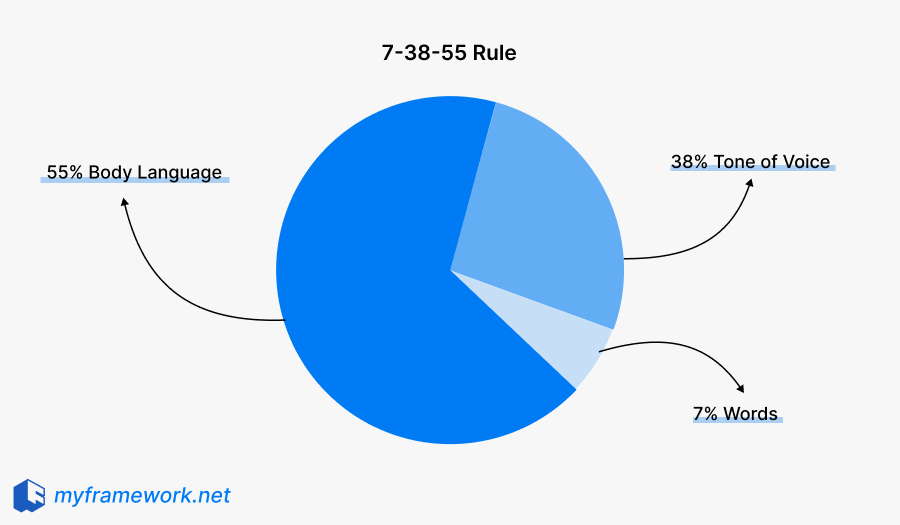
This rule helps us understand why tone and body language matter in communication. It is widely used in public speaking, leadership, and daily conversations.
7-38-55 Rule is about how people understand emotions in face-to-face communication. They will judge your communication based on:
This means that when words and nonverbal signals do not match, people trust nonverbal cues more.
For example, if someone says, "I'm fine" but looks upset and speaks with a shaky voice, we believe their body language and tone, not just the words.