Communication
Pyramid Principle: Unlock Clear System Thinking
Structured communication framework which is supporting your point with logically organized details and effective information delivery.
Applications
Framework Card
Pyramid Principle
- Goal
- Communicate complex ideas with clarity and logical structure.
- Flow
- Main point → Supporting arguments → Evidence
- Best For
- Structured communication; Logical problem framing
Why This Matters
Many people struggle to present ideas in a clear and convincing way. Long explanations or unstructured arguments often confuse the audience. This makes decision-making harder and weakens the impact of good ideas.
If so, the Pyramid Principle can transform your communication and thinking process.
What Is the Pyramid Principle
The Pyramid Principle was developed by Barbara Minto at McKinsey & Company. It is a system thinking approach that helps organize communication in a logical and structured way.
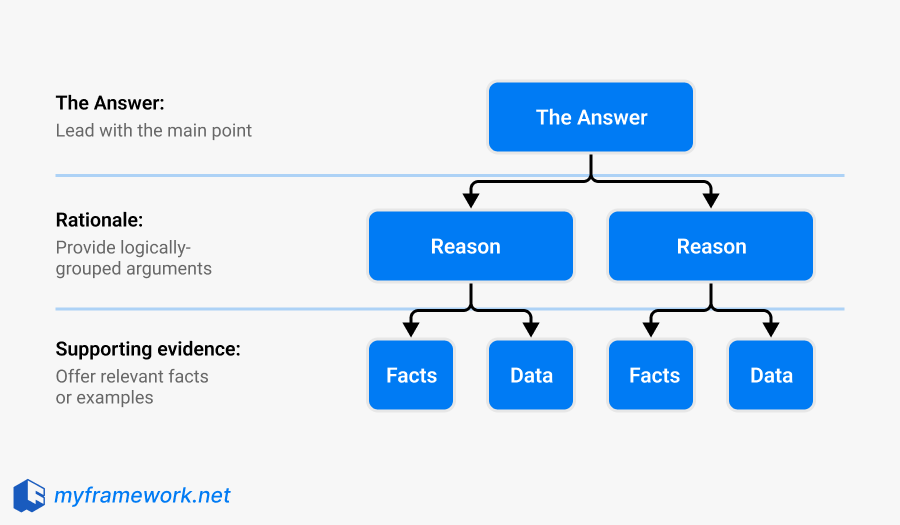
The method uses a pyramid shape to arrange ideas: start with the main point at the top, then support it with key arguments, and finally provide detailed evidence at the base.
Minto used the metaphor of a pyramid to emphasize the importance of starting with the most important point or conclusion (the apex of the pyramid) and then building upon it with supporting layers of information (the descending layers of the pyramid).
This principle is used in business communication initially, and now it has become one of the famous system thinking models to help people structure and present ideas in a logical and persuasive manner.
Visualization of Pyramid Principle
Advertisement
How Does Pyramid Principle Work
The Pyramid Principle is based on three key rules:
- Start with the answer first – Communicate the main message before details. It could be a conclusion, even an assumption.
- Group related ideas – Organize supporting points into clear categories.
- Follow a logical order – Present ideas in a sequence that builds understanding. It's like explanations to support your statement.