Personal Development
Peak–Trough–Recovery Model: Mastering Your Energy, Not Just Your Time
Knowing where you are helps you choose what to do next with intention instead of habit.
Applications
Framework Card
Peak–Trough–Recovery Model
- Goal
- Improve performance by scheduling work around energy patterns.
- Flow
- Peak → Trough → Recovery
- Best For
- Energy based task planning; Burnout prevention
Introduction
Most professionals manage their schedules by the clock. They fill every hour with tasks and push through fatigue to stay productive. Yet what truly limits performance is not time, but energy.
Throughout the day, your energy naturally rises and falls. Some hours you feel sharp and creative, while others feel slow and draining.
Don't take this on yourself; it is more than the rhythm of a human being.
Ignoring this rhythm leads to wasted effort and lower focus.
What this framework is
The Peak Trough Recovery Model helps you understand and manage these natural energy cycles.
Developed from behavioral science research by Dan Pink, it shows how mental energy follows a daily pattern of highs, lows, and rebounds.
By aligning your most demanding work with your peak periods and saving lighter tasks for your lower-energy hours, you can work smarter, stay focused, and recover more effectively.
Advertisement
How the framework works
In this model, Dan Pink divided a day into 3 stages, and each day follows a predictable emotional and cognitive curve:
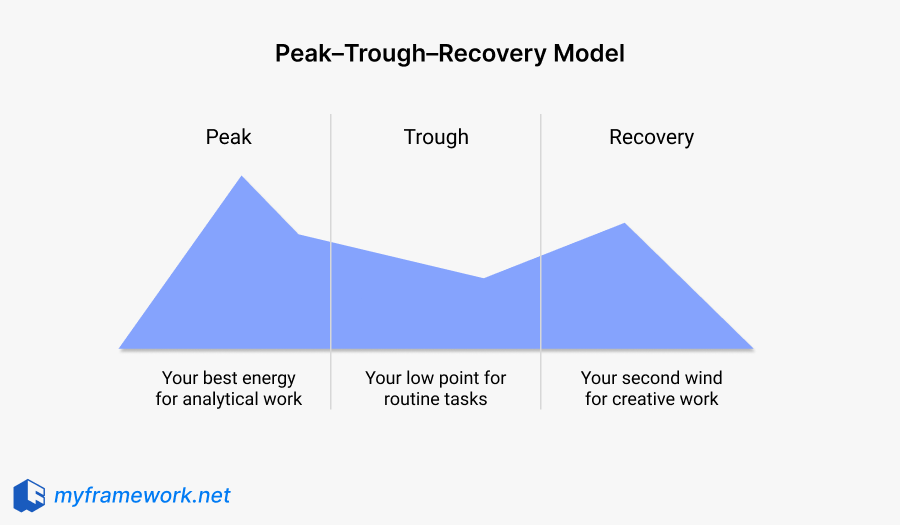
The model reveals that productivity is not a straight line.
Peak
Usually, you reach the peak of the day in the morning. This is your high-performance window. Focus, alertness, and analytical thinking are strongest.
It is ideal for deep work, problem-solving, and decision-making. For most people, this occurs in the morning hours after waking and stabilizing.
Trough
When it moves to the second stage, energy dips and attention declines. Mistakes are more likely, and motivation drops.
The trough is not the time for complex work but for routine tasks, checklists, or short breaks that help you reset.
Recovery
Later in the day, mood improves and creativity rebounds. Logic weakens slightly, but flexible thinking returns.
This phase suits brainstorming, collaboration, or planning sessions that need open-mindedness rather than precision.