Maslow's Hierarchy of Needs: The 5 Levels of Human Motivation
Famous model in psychology and helps us understand what motivates people.
Applications
Framework Card
Maslow's Hierarchy of Needs
- Goal
- Understand the root drivers of human behavior.
- Flow
- Survival → Safety → Belonging → Esteem → Self-Actualization
- Best For
- Leadership; Team Building
Check-in
Before you push for performance or growth, check if the basics are in place. Are fundamental needs being met, or are you expecting motivation without stability? When results feel stuck, the issue is often not capability, but unmet needs at a lower level.
What this framework is
The Maslow Demand Level Model, also known as Maslow's Hierarchy of Needs, is a psychological theory created by Abraham Maslow in 1943. It is one of the most famous models in psychology and helps us understand what motivates people.
Maslow created this model while working as a psychologist. He wanted to understand what drives people beyond just basic survival. He studied successful people like Albert Einstein and used ideas from humanistic psychology, which focuses on personal growth and reaching one's potential.
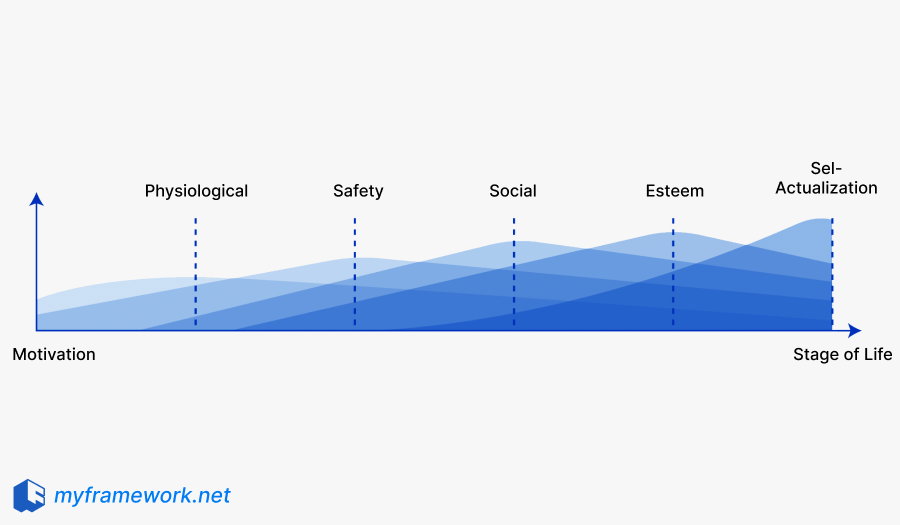
The model shows a pyramid of human needs, starting with the most basic needs and moving up to higher-level needs, ending with self-fulfillment.
Advertisement
Core Concept: The Hierarchy of Human Needs
The main idea of Maslow's model is that human needs are structured like a pyramid, with lower-level needs needing to be met before higher-level needs can be focused on. The hierarchy has five levels:
- Physiological Needs: Basic needs like food, water, sleep, and shelter.
- Safety Needs: Feeling safe, having financial security, and stability.
- Social Needs: The need for love, belonging, friendships, and social connections.
- Esteem Needs: Respect from others, self-esteem, recognition, and achievement.
- Self-Actualization Needs: The desire to reach one's full potential, personal growth, and fulfillment.