Communication
SCR Framework: The Tool for Concise Updates
Resolve complications with concise, executive-ready solutions.
Applications
No application mappings are available for this framework yet.
Framework Card
SCR Framework
- Goal
- Eliminate confusion in emails and briefings by providing context before the solution.
- Best For
- Status Updates; Crisis Management
Why Messages Often Get Lost
In some discussions, people often jump straight into details without giving context. This leaves listeners confused and weakens the impact of the message.
To communicate clearly, you need structure.
The SCR Framework provides a simple way to build strong communication skills and keep workplace communication sharp and effective.
What this framework is
The SCR framework is a simplified version of the well-known SCQA communication framework, both designed to structure messages for clarity and engagement.
SCQA, developed by Barbara Minto, is widely used to convey complex ideas by guiding the audience through a narrative that flows logically from a situation to a final answer.
SCR framework is more direct, focusing on presenting a solution to the complication without explicitly framing it as a question.
Advertisement
How the framework works
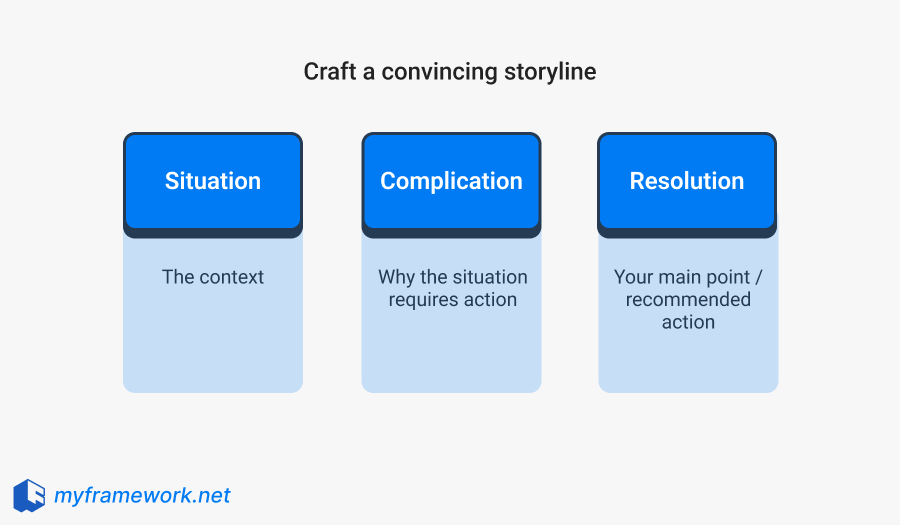
Situation: Introduces the current state or background.
Complication: Explains the problem or challenge arising from the situation.
Resolution: Offers a solution or resolution to the problem.
While both SCQA and SCR share similarities, their key differences lie in their approach to resolving complications and guiding the audience through the content.