Marketing
Freytag’s Pyramid: Structure Compelling Business Narratives
Helps communicators control emotional rhythm and attention over time.
Applications
No application mappings are available for this framework yet.
Framework Card
Freytag’s Pyramid
- Goal
- Structure presentations so the audience stays engaged from setup to payoff.
- Best For
- Project Narratives; Leadership Speeches
Why This Matters
Many stories fail not because the idea is weak, but because the structure is flat.
In business communication, presentations often start too slow, peak too late, or end without resolution. As a result, audiences lose attention, miss the key point, or forget what mattered most.
Freytag’s Pyramid solves this by giving you a clear narrative arc that builds tension, delivers impact, and lands with clarity.
What this framework is
Freytag’s Pyramid is a classic storytelling structure developed by German novelist and playwright Gustav Freytag.
It breaks a story into seven stages that move from setup to tension, reach a peak, and then resolve cleanly. While it originated in dramatic literature, it is widely used today in storytelling, presentations, speeches, and brand narratives.
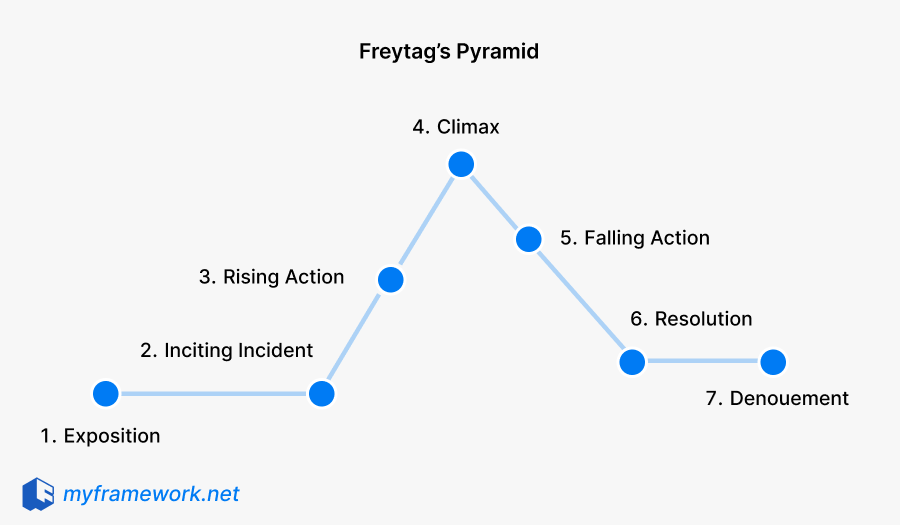
The model helps communicators control emotional rhythm and attention over time.
Advertisement
Core Concept of the Framework
Exposition
This is the introduction. You set the context, define the characters or stakeholders, and explain the situation.
In business, this could be the market context, the team, or the starting problem.
Inciting Incident
Something changes. A trigger appears that disrupts the status quo.
This could be a new challenge, a missed goal, a customer complaint, or a market shift.
Rising Action
Tension builds as actions are taken and obstacles appear. The audience starts to care because the outcome is uncertain.
In presentations, this is where complexity and stakes increase.
Climax
This is the turning point. The conflict reaches its peak.
A decision is made, a strategy is chosen, or a critical moment occurs. Everything before this leads here.
Falling Action
Tension begins to ease. The consequences of the decision unfold. You show what changed and how the situation starts to stabilize.
Resolution
The core conflict is resolved. The problem is addressed, the goal is reached, or a clear outcome is achieved.
Denouement
Loose ends are tied up.
You reflect, summarize lessons, and leave the audience with closure and meaning.