Communication
3A Trust Model: Build Trust Fast at First Meeting
Gives you a simple and clear structure to build trust fast.
Applications
No application mappings are available for this framework yet.
Framework Card
3A Trust Model
- Goal
- Eliminate doubt and establish credibility quickly in new relationships.
- Best For
- New Managers; Client Meetings
Struggling to Gain Trust?
Something might always trouble you when you’re reporting to a new manager, working across departments, or meeting a client for the first time.
Do they think I’m credible? Will they take me seriously?
You might think the trust is hard to earn, but the truth is, people decide whether to trust you very quickly
What this framework is
The 3A Trust Model is a simple and effective way to earn trust from the first moment.
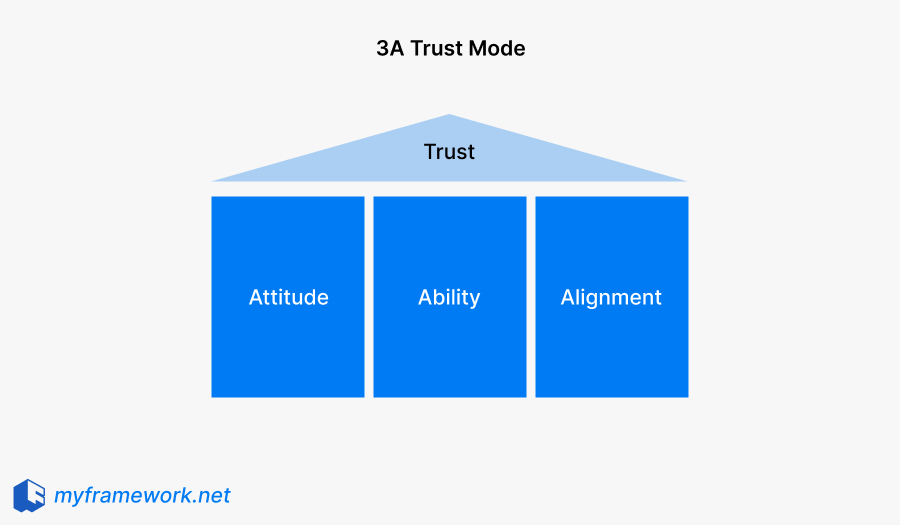
It includes three building blocks:
- Attitude
- Ability
- Alignment
The beauty of this model is, it breaks trust down into three key factors: attitude, ability, and alignment. This gives you a clear structure to build trust fast, instead of guessing what to say or how to behave.
Advertisement
How the framework works
Attitude – Show willingness to cooperate
People trust you faster when they feel you're open, respectful, and willing to work together. Especially in first-time interactions, others often judge your reliability based on your mindset, not just your skills.
To show the right attitude, introduce yourself clearly without dominating the conversation. Use inclusive language like “we” and “together” to reduce distance. Show that you respect the other person’s role and contribution.
Example:
“I’m glad we’re working on this project together. I heard you led a similar project before — very impressive.”
“I’ve already prepared some materials so we can align quickly.”
Key takeaway: Make people feel you’re “on their side,” not “on the other side of the table.”
Ability – Demonstrate you can solve problems
Trust isn’t built on promises, it’s built on proof.
People want to know you can deliver results. Your ability comes from your expertise, experience, and how stable and reliable you seem. We mentioned that skill is not judged at the very beginning, but if you want to take one step further, you have to demonstrate.
Instead of listing your resume, clearly state the problems you’ve solved. Speak with data or outcomes, such as time saved, cost reduced, or success stories. Use the “three-sentence rule” to express your value concisely and confidently.
Example:
I led Project A last year. From planning to delivery, it took under six months and helped the client cut costs by about 20%.
Key takeaway: It’s not about how impressive you sound, but whether you can solve their current problem.
Alignment – Show your goals match theirs
The deepest trust comes when people believe you are working toward the same outcome. You need to show that you’re here to help them succeed, not to compete or create extra work.
To build alignment, first confirm that you understand their goals. Then explain what you can do to support them. Use phrases like “we both hope to...” to create common ground and shared commitment.
Example:
We both hope this project can move forward quickly. I can offer support in three areas to help you get fast internal approval.
Key takeaway: When you make it clear that you also want things to succeed, people are more willing to let you be part of that success.