Communication
Winston’s Star: 5 Steps to Make Your Ideas Stick
Apply five communication elements to make ideas memorable and repeatable.
Applications
No application mappings are available for this framework yet.
Framework Card
Winston’s Star
- Goal
- Make complex ideas stick by combining emotional hooks with intellectual clarity.
- Best For
- Public Speaking; Writing Reports
Why Do Good Ideas Get Forgotten?
You may have given a great speech or written a detailed report, but people still forget it. This happens more often than we think—not because the idea wasn’t good, but because it wasn’t delivered in a way that made it stick.
To help people solve this problem, Patrick Henry Winston, a well-known professor at MIT and a pioneer in artificial intelligence, introduced a simple but powerful model called Winston’s Star.
This model appears in his book Make It Clear: Speak and Write to Persuade and Inform, a guide designed to help readers enhance their speaking and writing skills.
What this framework is
Winston’s Star includes five simple but powerful elements: Slogan, Symbol, Salient Idea, Surprise, and Story.
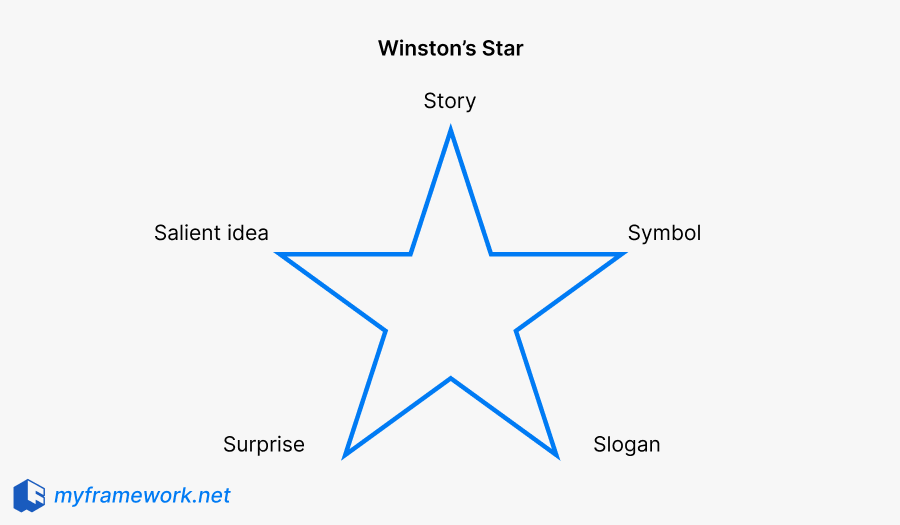
When these are used together, they help your audience understand your idea, remember it, and even repeat it to others. Let’s take a closer look at each part.
Advertisement
The Five Points of Winston’s Star
Slogan – A Clear and Catchy Phrase
A slogan is a short phrase that captures the core of your idea. It works like a headline and it should be easy to remember and easy to say.
In a report, you might use it in the title, abstract, or conclusion. In a talk, you might say it out loud and repeat it for emphasis.
For example, in Winston’s own research, projects had names like Genesis (a system for story understanding) and Watson (a game-playing system). These names weren’t random—they acted as slogans that helped people remember the key work behind them.
Tip: Try using a phrase with rhythm or repetition. Make it short and catchy.
Symbol – A Visual or Object That Represents the Idea
People remember images faster than words, so choose a symbol that connects directly to your message.
This could be a simple drawing, a meaningful object, or even a mental image that supports the slogan.
A famous example mentioned in the book is Charles Minard’s chart showing Napoleon’s invasion of Russia. It turned a complex story into one powerful visual that communicated loss and failure at a glance. Over time, the image itself became a symbol of the idea it carried.
Tip: Keep your symbol simple and easy to recognize. One strong visual is better than many complicated ones.
Salient Idea – The One Big Thing You Want People to Remember
Even in long talks, people usually remember only a few key ideas. That’s why it’s important to highlight your most important point clearly and directly. Winston called this the “salient” idea—it stands out.
For example, instead of trying to impress your audience with ten smart thoughts, pick one or two strong ones and say them with clarity. Add your slogan to this part, so the idea becomes both clear and memorable.
Tip: Use phrases like “If you remember only one thing from today, it should be this…” to signal your main point.
Surprise – The Element That Breaks Expectations
Surprise grabs attention.
People are naturally curious when something doesn’t go as expected. In speeches or reports, surprises can come from unexpected facts, a sudden twist, or a striking contrast.
The surprise should connect to your idea. A surprise without meaning won’t stick.
Story – The Human Element That Creates Connection
Stories are the emotional engine of communication.
A good story answers (Find more Storytelling techniques) questions like: Who had this idea? What problem were they trying to solve? What did they go through? People remember feelings more than facts, and stories deliver both.
Tip: A short, true story that shows struggle, curiosity, or a turning point works best. It builds trust and makes your idea feel real.